




Reducing your Carbon Footprint with Biodiesel
Springboard Biodiesel, LLC is committed to helping build an alternative energy infrastructure that ultimately replaces petroleum with sustainable, renewable, alternative energy sources that help protect our environment.
It is well known that biodiesel has a significantly beneficial emissions profile in comparison to diesel fuel. Multiple studies suggest that for every gallon of biodiesel burned, between 78% (EPA) and 90% (CA. Air Resources Board) less CO2 is emitted into the atmosphere.
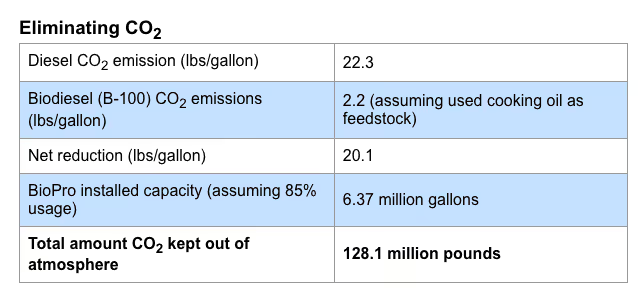
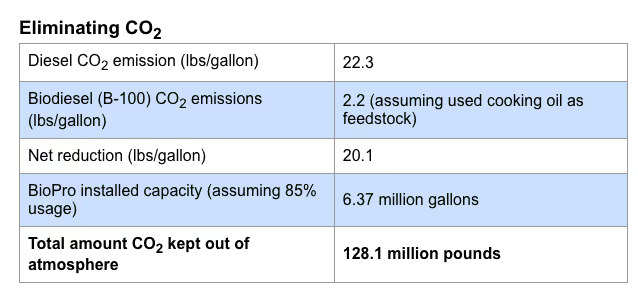
Given this compelling fact, we are proud to announce that in 2012, our customers installed approximately 128.1 million pounds of CO2 abatement capacity, thereby doing their part to help build a future alternative energy infrastructure that is good for the planet and good for their fuel budget!
The US EPA has spent a lot of time studying biodiesel. In fact, no other alternative transportation fuel has been as thoroughly vetted. Here is what they’ve concluded:

Basically, they have tested biodiesel every which way and concluded that it’s emissions are significantly less than dirty diesel. Now, California’s Air Resource Board will also tell you that if you make biodiesel from waste vegetable oil (we refer to it as “recycled”) you will actually reduce your carbon emissions by 90%. [Biodiesel and Renewable Diesel, California Air Resources Board]
What does this mean? If you feed people, you can make biodiesel.
Given that diesel #2 is known to spew 22.3 pounds of CO2 per gallon, if you substitute 1 gallon of B-100, made from recycled vegetable oil, for 1 gallon of diesel # 2 you will save 19.6 pounds of CO2 from contributing to the warming of your planet. If you use virgin soybean oil, you’ll only save 17.3 pounds.
Either way, we hope you’ll agree that biodiesel is good for your planet. And Springboard Biodiesel is proud of the fact that our 1000+ BioPro™ biodiesel processors represent over 8MM gallons of annual production capacity, which means that we could potentially be assisting with the extraction or abatement of over 152MM pounds (76,000 tons) of CO2 annually!
Finally, it is important to note that diesel particulate matter is one of the deadliest airborne carcinogens. According to one source, diesel particulate matter is 10X more carcinogenic than all other airborne pollutants combined! B-100 cuts particulate matter in half. [Diesel Exhaust and Cancer, American Cancer Society]
Use your BioPro biodiesel processor to save money and help reduce green house gas emissions at the same time. You and your customers will appreciate your "biopro-ficiency".
Frequently asked questions
How much less CO2 does biodiesel emit than petroleum diesel?
Studies estimate that biodiesel cuts CO2 emissions by 78% to 90% per gallon compared with petroleum diesel. The lower figure comes from the U.S. EPA, and the higher one from the California Air Resources Board (CARB) for biodiesel made from waste vegetable oil.
The EPA has studied biodiesel more thoroughly than any other alternative transportation fuel. It concluded that biodiesel's emissions are significantly lower than those of petroleum diesel.
How many pounds of CO2 does one gallon of biodiesel save?
Burning a gallon of #2 diesel releases about 22.3 pounds of CO2. Replacing that gallon with B100 made from recycled vegetable oil avoids about 19.6 pounds of CO2. B100 made from virgin soybean oil avoids about 17.3 pounds.
The savings grow with every gallon replaced, so fleets and farms that burn a lot of diesel see the largest totals.
Is biodiesel from used cooking oil better for the climate than biodiesel from virgin oil?
Yes. Biodiesel made from recycled oil has a lower carbon footprint than biodiesel made from virgin crop oil. The California Air Resources Board estimates that biodiesel from waste vegetable oil reduces carbon emissions by about 90% compared with diesel.
Per gallon, B100 from recycled vegetable oil avoids about 19.6 pounds of CO2, compared with about 17.3 pounds for B100 from virgin soybean oil. Any business that serves food and produces used fryer oil has feedstock for this lower-carbon fuel.
Does biodiesel reduce diesel particulate matter emissions?
Yes. Running B100 cuts particulate matter emissions roughly in half compared with petroleum diesel. This matters for health because diesel particulate matter is considered one of the most dangerous airborne carcinogens.
Particulate matter is a mix of fine solid particles and liquid droplets, including soot, that can be small enough to inhale deeply into the lungs. Reducing it benefits equipment operators and anyone nearby, such as workers around loading docks, farm equipment, and school buses.
How much CO2 can BioPro biodiesel processors help avoid each year?
More than 1,000 BioPro processors represent over 8 million gallons of annual biodiesel production capacity. Replacing that much diesel could potentially avoid more than 152 million pounds (76,000 tons) of CO2 each year.
In 2012 alone, BioPro customers installed about 128.1 million pounds of CO2 abatement capacity. Each processor pays off twice: the owner saves on fuel costs and cuts the emissions tied to every gallon of diesel replaced.



.svg)
