




Five Tips for Storing and Retrieving Biodiesel During Winter
Many biodiesel producers slow down or halt their production of biodiesel during the winter months. As a result many customers will store their BioPro for some period of time. To avoid potential problems associated with neglect or poor storage, Springboard Biodiesel recommends its customers perform the following processes to ensure an easy and trouble-free return to biodiesel production.
Please perform these steps while your machine is empty of biodiesel and all chemicals!
- Water removal from the water-in pump: Disconnect your water in pump from its water source and remove your clear suction tube from your static barrel (if applicable). Manually turn on the water-in pump switch located on the front of your machine and watch the water mist into the machine until it turns into drops. This usually takes less than 15 seconds – watch carefully so as not to damage the pump by running it dry. Once you see the droplets of water, turn off your water-in pump. You have now successfully cleared your water in line on both sides of the water in pump.Water removal from the water-in pump: Disconnect your water in pump from its water source and remove your clear suction tube from your static barrel (if applicable). Manually turn on the water-in pump switch located on the front of your machine and watch the water mist into the machine until it turns into drops. This usually takes less than 15 seconds – watch carefully so as not to damage the pump by running it dry. Once you see the droplets of water, turn off your water-in pump. You have now successfully cleared your water in line on both sides of the water in pump.
- Water removal from the main tank body: If you left some water in the bottom of the main tank, you will need to remove it. Turn on your water-out pump and watch the water leave the machine, once you start seeing consistent bubbles in your water-out line, immediately turn the water-out pump off.
- Water removal from the water-out strainer: On the back of the BioPro you will notice that there is a water out strainer connected to the machine. This strainer protects the water-out pump, and it may still contain some water with its housing. There are two options for water removal: a) on the bottom of this strainer is a little nob that can be removed to drain the water therein, or b) remove the entire bottom of the strainer. This allows you to check the Strainer itself and make sure that the strainer is clear of any particulates that may have built up over time.
- Cleaning the Methoxide tank: Remove the 3” camlock cover of your methoxide tank. During the course of producing many biodiesel batches, it is not uncommon to create a methoxide “slush” at the bottom of the methoxide tank. It is important to remove this prior to storage (It is also good practice to check for this every 5 or 6 batches, so as to protect your pumps and ensure trouble fee processing). First pour in about half a gallon of vinegar into the methoxide tank. Re install the 3” camlock cap, thereby effectively closing the tank and turn on the pre-mix motor switch located on the front of the machine. Leave this on approximate 1–2 minutes. After switching off the pre-mix motor, remove your main tank lid and turn on the manual methoxide in switch. As you look in the main tank, you will notice a stream of white and yellow water. This water has trace amounts of catalyst and methanol in it, so be careful! You will start to see the stream change to clearer color. If this does not happen, you need apply more vinegar and repeat this step. Do this until you see a clear stream come out of the methoxide tank into the main tank.
Following this step, fill your main tank with water and vinegar (there will be the liquid in the tank from the methoxide clean step). Manually turn on the main stir motor for a few minutes, and this will clean the tank rather well. Note: When adding vinegar to your main tank we recommend adding at least one full gallon and adding enough water to cover the propeller by a few inches. - Finally drain off any excess fluids from the main tank and you are ready to store your machine.
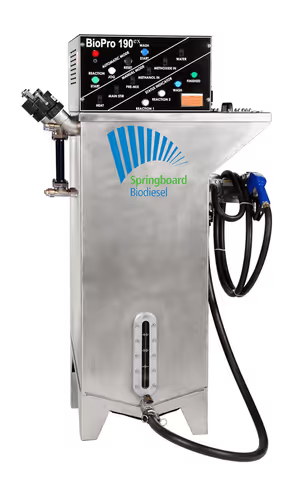
This process is the best way to store your BioPro
By following these steps, your BioPro will be ready to produce biodiesel when next needed. However, it is always prudent to give your BioPro a thorough visual inspection after a prolonged period of storage (ask us about the Cutter Bees).
Performing a Water Test
In addition, Springboard Biodiesel recommends that you perform a quick water test, prior to resuming production. Connect everything back up as if you were going to process a batch of biodiesel, but instead fill the methoxide and methanol tanks with water. Fill your main tank with water and vinegar again, fill to a few inches over the main motor's propeller. At this point, turn the machine on by pressing the start button. The machine will now perform all of the functions it would during biodiesel processing and will allow you to make sure everything is working properly After a few minutes the methanol side will pour its water into the main tank, leave in process for about 30 minutes. Then press the jog button, press this button twelve times until you hear the methoxide pump turn on and the water pumping in from that side. By doing this you will be able to test that your machine is working correctly and that your pumps are in good condition.
Frequently asked questions
Why should I winterize my BioPro if I stop making biodiesel over the winter?
Winterizing prevents problems that come from leaving water, catalyst, and chemicals sitting in the machine for months. Many producers slow down or stop making biodiesel in winter, and a BioPro left with water in its pumps, lines, and strainer, or methoxide slush in its tank, is more likely to have trouble when production resumes.
Clearing the water, cleaning the tanks with vinegar, and draining everything while the machine is empty of fuel and chemicals makes for an easy, trouble-free restart. Water left in pumps and lines can also freeze in an unheated space.
Why is vinegar used to clean a BioPro before storage, and how much do I need?
Vinegar is a mild acid that helps dissolve and neutralize the alkaline catalyst residue that builds up in the methoxide tank and main tank. Use about half a gallon in the methoxide tank, then at least one full gallon in the main tank with enough water to cover the propeller by a few inches.
Run the main stir motor for a few minutes to clean the main tank, then drain off the excess fluid. The rinse liquid carries trace catalyst and methanol, so handle it carefully.
How do I run a water test on a BioPro before restarting production?
A water test runs the BioPro through its normal functions using water instead of chemicals so you can confirm the pumps and controls work. Connect everything as if processing a batch, but fill the methoxide and methanol tanks with water, and fill the main tank with water and vinegar to a few inches above the propeller.
Press start and let it run for about 30 minutes; after a few minutes the methanol side should pump its water into the main tank. Then press the jog button twelve times until the methoxide pump turns on and water flows in from that side.
What should I check on a BioPro after months in storage?
Give the BioPro a thorough visual inspection before running a batch, then perform a water test. Look over hoses, fittings, the water-out strainer, and the tanks for debris, residue, or anything disturbed during storage, and make sure lines and pumps are reconnected properly.
The water test confirms that the methanol and methoxide pumps, the water pumps, and the controls all function before you commit oil and chemicals to a batch. Springboard Biodiesel can advise on specific issues found after prolonged storage.
How cold is too cold to restart BioPro biodiesel production in winter?
The BioPro is designed to operate in ambient temperatures of 50 to 100 °F (10 to 38 °C). Washing becomes especially difficult in the cold, and brewing is not recommended at all when the air around the processor is below about 40 to 45 °F, regardless of other precautions.
If your space cannot stay within that range, it is usually better to keep the machine winterized until conditions warm up, or to move it to a heated area. Cold feedstock and wash water also increase the risk of gelling and emulsions.



.svg)
