
Biodiesel Adventures in Papua New Guinea

Published

May 26, 2026

Biodiesel project event in Papua New Guinea

BIODIESEL ADVENTURES IN PAPUA NEW GUINEA

Biodiesel project event in Papua New Guinea

The Commissioning:

The vice chancellor’s twin brother flicks his tongue back and forth behind half-closed teeth when he listens. Though mildly disconcerting, this tick is also a “tell” and allows me to tell him apart from his equally tall and erudite brother, the vice chancellor, whom I met for the first time the day before. Both are enthusiastic about the biodiesel project. And they are both Adventists. In fact, everyone on the campus of the Pacific Adventist University in Port Moresby, Papua New Guinea, is an Adventist, except me.

Several months earlier, the university bought one of Springboard Biodiesel’s larger fuel making systems and asked that someone from the company come to install and train their staff and students on the proper use of the equipment. The war in Iran has boosted diesel fuel prices to all-time highs in multiple countries, including Papua New Guinea where the cost rose to 7.75 Kina per liter in April, the equivalent of $6.50 per gallon. The equipment purchased by the University will allow them to make an exceptionally clean burning fuel for 1.48 kina/Liter ($1.25/gallon).

The Adventists, I’ve learned, are interested in many things including health, the life of Jesus Christ, and biodiesel. And they tend to pray a lot, even before journeys in the car.

It turns out that the Prime Minister of Papua New Guinea, James Marape, is also an Adventist with the same interests. On Thursday, the day before the “commissioning” of this project, the Prime Minister made an announcement in Parliament alerting everyone to this alternative fuel making project happening at the University; several parliamentarians expressed interest in attending the event and are approaching the facility now on this Edenic campus, situated on a nature preserve, 14 miles North of the Capital.

A smiling minister arrives, the Minister of something. His hair is extraordinary in its Einstein-like wildness.

Students linger towards the back. A PA system has been set up hastily.

Linta, one of two leaders of this project, has lost her voice and will not be speaking today. Tirelessly, she worked and worried about this event all week. She also, single-handedly, saved this event from disaster:

The company that had promised to deliver methanol, and sulfuric acid, two essential ingredients for the production of biodiesel, failed to deliver on their promise on Wednesday and Thursday, so, as a contingency plan, Linta and Darren drove into town in “the tipper” truck on Thursday morning early and managed to secure the exact amount of both chemicals required to make the exact amount of biodiesel needed for this event. We needed 76 liters of technical grade methanol and that was precisely how much methanol could be found in town. Had she not organized this back up purchase, we would not have had biodiesel at this well-publicized commissioning event.

That would have been like having a grand opening for a much-anticipated ice cream shop where there is no ice cream.

The Vice Chancellor references Artemis 2 as a metaphor in his speech.

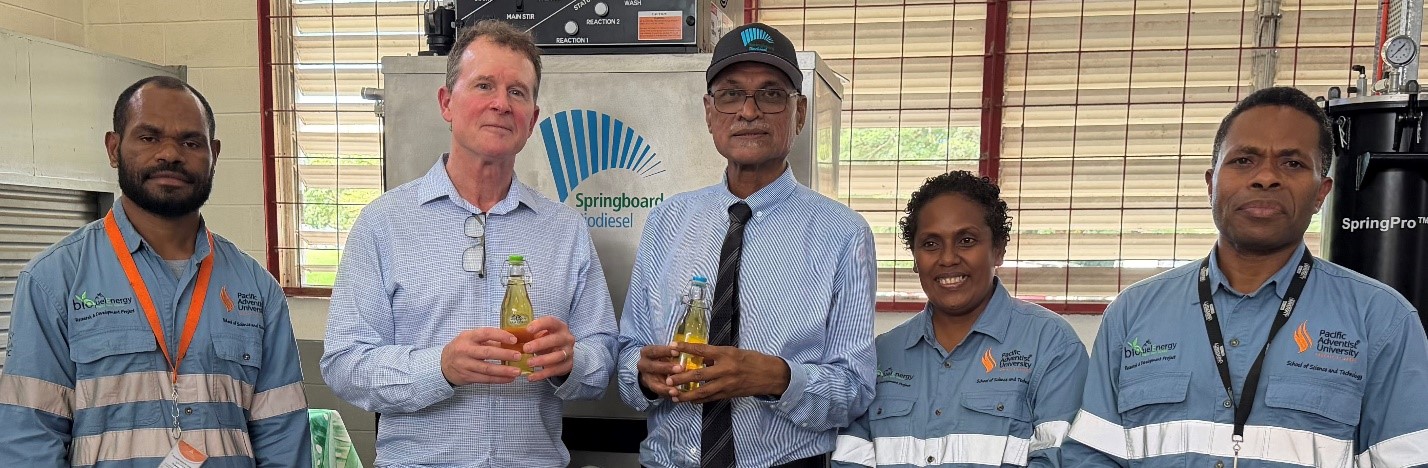
I run with that, giving an extemporaneous speech on the benefits of the fuel, the features of the equipment and the opportunity presented by the “crisis” in the middle east. I end the ceremony by presenting the Vice Chancellor with the operator’s manuals. Photographs are taken in front of the equipment as well as outside as a jerrycan of biodiesel is poured into the ironically named Supro Maxitruck T4. (It is not Supro big).

It’s amazing, but the event has gone off without a hitch AND, now that it’s done, I can execute the second half of my plan; a 4-day adventure to the North.

But first, Peter Skinner:

I am 100% fired up for the flight to Hoskins -wheels up at 3:15 pm- but a meeting with Peter Skinner at the Gateway Hotel buffet cannot, in good conscience, be avoided. Peter has been a fan and supporter of the company for 15 years, and has remained in contact, but he has never been able to pull the funds from the Coconut industry, that he peripherally serves, to buy equipment. He has valuable contacts and banks of obscure knowledge and he knows about the Middlesons up on Karkar island, a family that’s been successfully making biodiesel from coconut oil for 18 years.

It will be tight timing, but I can’t avoid seeing him for lunch and am curious to meet him.

I have no idea what he will look like, having never met the man in person, but I know I will know him immediately when I see him and I do. A tall white Australian man with voluminous greying hair sits in the outdoor section of the restaurant scanning the parking lot.

Peter and I have an intense 30 minute conversation over lunch during which he reminds me that he is working to get funding for a high yield seed crop called Pongamia which, he says, grows explosively in the PNG climate.

Samuel Beckett once said “I wouldn’t have my youth back. Not with the fire that’s in me now.” Sitting opposite Peter Skinner at the Gateway Hotel, just prior to getting on a domestic flight north in Papua New Guinea, I feel the Beckett fire.

“You’ve gotta be ready to be ready!” I tell Peter, channeling my brother. He agrees. It’s like a psychic handshake.

We part in good spirits, better friends for having made the time to meet each other.

Domestic Flight:

The domestic terminal in Port Moresby is not a high security facility. I could have smuggled 30 lbs of gelignite on to that turbo jet had I felt that way compelled. Nor is it elegant. Cracked seats, tired peeps, and a flight board that looks like it was made in the first days of Atari video games.

On the flight to Hoskins in West East Britain, the countryside of Port Morseby evaporates and is replaced by the wilds of PNG, an immutable jungle sprawling in all directions. Wide, serpentine rivers, mountains and volcanoes, we fly over the substantial sea gap between the two islands, the land reappearing as New Britain. It’s a 1 hr 30minute flight on a Turbo prop plane run by Air Niugini. I sit next to a graduate student from Boston College named Zoe. Small world. This is her Eighth time flying in and she will be staying at a marine biology research center adjacent to the Walindi resort. She reminds me of my niece and wears the same octagonal glasses.

The Road to Kimbe:

The road to Kimbe from Hoskins is a monument to neglect, a rutted spasm of colonial enterprise gone to seed, riddled with potholes and wash outs. It was built by a French company called Dumez in the late 1960s, to support the “Hoskins Oil Palm Scheme” (Marketing suggestion: never include the word “scheme” in your project title) It was built using crushed coral as its base -not an environmental concern at the time- and according to Steve Welsh, a man I’ll meet later at Walindi, it was the finest road in PNG when it was first built “with a 7 inch base”. Now it’s a nerve shattering disaster in desperate need of drainage.

Nick the driver of the Toyota cruiser bus, expertly avoids potholes, weeving and swerving, but the sun is going down and as it gets darker, potholes sneak up on him; he doesn’t always deaccelerate in time; the resilience of the Toyota Cruiser bus is tested and I’m praying like an Adventist that a tire doesn’t blow. I sit front row just behind Nick and a man who sits shot gun who never says a word. Nick and his friend have betelnut teeth; their mouths and lips and teeth have been made a dull rusty orange color by the popular stimulant that is chewed, like Copenhagen, in this country, and then spat out in great red jets that look a lot like blood.

The faces of people we pass on that road, are hard and expressionless. It’s poor here. Apart from the road, there is no infrastructure. Up ahead, a bridge has been washed out, from the recent flooding caused by typhoon Maisa. Without hesitation, Nick navigates off the road, down an embankment, through a small river and back up the embankment on the other side, wheels sliding briefly in the mud and suddenly gripping. A high percentage of vehicles in Papua New Guinea have something called a snorkel which rises from the exhaust up to the roof and allows vehicles to go deep into rivers without stalling out the engine. This Toyota Cruiser bus does not have a snorkel but makes it across the river anyway.

Road to Kimbe in Papua New Guinea

As it darkens, small fires appear on the sides of the road. By the time we get to Kimbe, the view of the ocean to the right has disappeared in the darkness and it is clear we are very far and very deep into this immeasurable and mysterious place.

We arrive at the Walindi resort after 80 minutes on the road, and pass through hidden metal gates guarded by security. When I was planning this part of my trip, I’d briefly considered renting a car at Hoskins airport and making this drive on my own. Google claimed there was an Avis office at Hoskins but no one ever answered the phone, thank all Gods. Had I rented a car, I would have passed by the resort – no signs-and -who knows-never been seen again. It’s not difficult to imagine grim outcomes; my body found on the outskirts of a town called Pongalu or Bitakara. “Biodiesel equipment manufacturer found dead in Wangor Bay” the headline might read. The imagination springs to life, fertile in the remote.

Colonial Pool:

A young American couple approaches the front desk just in front of me at the Main House and I have time to look around. An abundance of shy service people materialize, all of them local, dark-skinned women. The handful of visible guests are all white. The young white woman in front of me has many questions.

That’s when I see the pool and experience a primordial sense of relief.

Pool at Walindi resort in Papua New Guinea

This beautiful blue pool, lit from within, with infinity aspirations, is recessed into the giant hardwood deck of the main lodge. The pool is probably 9 meters long and 3 meters wide and it resides about 8 meters from the ocean. It’s existence here, in this place, is so improbable and welcome that tears of gratitude swim in my eyes.

It’s marvelous and calming, the blue heart of this Colonial oasis.

Dinner:

A fast-talking, bald headed Canadian man named Colin is summoned and assures me that the dive shop has all of the equipment I’ll need for tomorrow’s dive.

Dinner is served at 7. I take a quick shower in Bungalo 3, change my clothes, put on a nice shirt and rush back.

I sit at a table with an older woman named Cecilie Benajmin who, it turns out, founded the resort with her husband Max, now deceased, back in 1983. She has encyclopedic knowledge about the history of this place, the palm industry, the reefs, World War 2 and it’s not hard to get her talking. Zoe, the Boston college student, and her colleague who might be named Brianna and a third young person named Fletcher are there; Fletcher is British and does a poor job of pretending to be jaded and world weary. We all share a table, and this includes the young couple.

The young couple from London are actually Americans. Michael, whose last name is Jordan and who is the physical antithesis of that famous athlete, is from Hudson, Massachusetts. Unbelievable. I tell him that I’m from Groton, MA. and we take turns imitating the local towny accent to the delight and confusion of the table. (Zoe gets it) His girlfriend, Maia is from Texas near the border of Oklahoma, “not near the panhandle”. The two of them are hideously intelligent and well-traveled. And I suspect that Michael is going to propose on this trip. (He'd be a fool not to. Maia is beautiful and intelligent.) I also suspect that Michael is either Autistic or a genius or both. He’s cool and weirdly disconnected most of the time, but will occasionally come into intense focus and share something potentially life changing about gene splicing or the “Cargo Cult”.

He works in IT -which might explain everything- and he tells the story at one breakfast about working with Indian support groups for Google who have been left inappropriately in charge of determining what is appropriate on the internet for cultures they know nothing about. He concludes an uncomfortable story with: “There’s some dark stuff that happens in IT that’s hard to explain.” Maia works for a large insurance company. They’ve lived in London for 3 years, but they met in Singapore and both are avid divers. They are here, as all of us are, to dive and witness the biodiversity that is happening off the coast of Kimbe in West New Britain, a central point in “the Coral Triangle”.

Half Day:

Boat outing near Walindi in Kimbe Bay

That first morning, I go out for a “half day” of snorkeling on a motor boat that has two enormous Suzuki gas engines on the back. Monster engines. Maia and Michael are with me, as is a South African couple. The female South African and I go snorkeling while Mia and Michael drop down 20 to 30 meters in scuba gear. The male South African stays in the boat. “There’s things down there that’ll eat ya” he says. I point out there are things up here that will too.

The snorkeling is absolute; time transforms underwater.

A third swimmer is with us, a local guy named Brooky whose sole job is to make sure that no one from the Resort drowns. The value of his job cannot be overstated. When he realizes I’m a strong swimmer, he focuses more on the South African woman and I am left to explore the reefs on my own. The South African’s words reverberate in my brain after a nurse shark, about my size, swims past like a dart. The terror is in how fast it moves.

Blue iridescent fish, clown fish hiding in anemonies, brain coral the size of a car. Baricuda and jelly fish. The underwater world is thick with color and creatures and coral. I’m called back to the boat for “tea”. Michael and Maia reemerge looking stunned, puffy and high from over-oxigenation and we have coffee and biscuits before going to another reef 20 minutes further out, a place called Restoff island.

As we are approaching the island I ask Dominick, the captain of the boat, if anyone lives on this tiny island, he says "just bats".

And it's the bats that put me in mind of 1990s Cambodia. In many ways, these two places PNG and Cambodia are similar, and the bats bring it together for me. The only difference: the tribes people in PNG are too hungry to take hostages.

Contemplating safety:

This area is jungle. this area is tribal. According to the loquacious Canadian named Colin, there are "troubles" in the villages, and there are places up in the mountains where "we don't go".

Our collective appreciation for the unpredictability of the clans and tribes in this region is enhanced at breakfast one morning, when the local tour guide, Joseph, explains to several of us over eggs that the tour to the WW2 crash sight will not be happening today because of an altercation in one of the villages in that area.

What happened? Several of us ask at the same time.

Joseph makes the classic one-handed slashing motion across his neck.

Eyes widen at the table.

He explains that there was a dispute, possibly over the ownership of a pig, and the outcome was that some unfortunate person had their head cut off.

Steve Welsh launches into a freakishly funny description of the bush knife (Machete) and how it should really be sharper. “There’s a lot of unfortunate hacking required to get a head clean off”.

Nervy laughter.

People keep telling me that the Walindi Plantation Resort is very safe. That it’s protected by a thick security detail. I do see people with flashlights creeping around the grounds at night; I sleep better believing it’s security. Additionally, there’s default security provided by the geography of the resort. The resort is located within the coastal area traditionally inhabited by the Bakovi, one of the seven major tribes in the province, and evidently, other tribes do not mess with the Bakovi. They are feared.

I’ve seen the outer wall of the resort and it could be taller.

and I watch myself.

Steve Welsh

Everything interesting seems to happen in the morning.

One morning, I meet Steve Welsh, a colorful Australian man who’s been living in PNG for 18 years and builds hospitals. He tells me at breakfast that he first got his start in PNG when he helped build biodiesel equipment on Karkar island for a family called the Middlesons.

I cut him off right there, mid-sentence, and shout “no fu#$-ing way” -service people scatter- while I explain why I’m in the country.

We’re both sort of amazed. I more than he. How many people in this country can be familiar with the biodiesel production process and also be at this resort in West New Britain?

Steve quickly becomes my hero. He tells stories well and endlessly and is adept at making others feel good about what they’re doing. “good on ya mate”. He excels at approval.

At dinner one night, he holds forth like a performer; he tells us that when he graduated from boarding school there was a whole series of parties thrown at the houses of graduates and at these parties, according to tradition, every graduate had to give a performance of some kind. He would recite poetry. “Oh I could recite all of Xanadu by Coleridge, without missing a line, after drinking a lot, and in any position.” His back up was the Jabberwocky by Lewis Carrol. And we agreed that “If” by Rudyard Kipling would’ve been an excellent pick. He owns two barges and uses them to move heavy equipment from building site to building site along the coast.

He looks older but he’s my age, born in 1966, and proud to be a Fire Horse.

“That’s what it’s all about mate, running fast while on fire!”

When Cecelie, the owner, pointed out that Oscar Wilde was slightly gay, Steve had to clarify: “Oscar Wilde was not slightly gay mate. He was a full-on scream’ah”.

Let’s not talk about the War

A German woman and her protégé are not giving much away when I ask what they’re doing here. The German woman is arrogant and overfed and smokes while exuding self-importance.

I thought she was here in support of independent alternative energy. That’s what Loreen, the retired software co. employee from Florida told me. But the German woman is distinctly uninterested in sharing what she does, and even less interested in anything having to do with clean energy. Her friend Molerca is even more stingy with her personality so I won’t talk about them.

James Bond:

The young “world-weary” British kid named Fletcher who studies clown fish, proclaims with confidence at dinner one night that his two favorite James Bonds are Pierce Brosnan and Roger Moore and, perhaps unfairly, I decide Fletcher shares a category with Oscar Wilde. The supposition is based equally on the pronouncement as well as the picks. Though now he seems to have taken an interest in Octagonally bespectacled Zoe. He’s trying.

Staying here as a young person would be the ultimate adventure.

I love it out here as much as any of them. More so. Instead of a trilingual newspaper, there's a school of marine research, with international visitors coming and going like rain clouds.

Squalls x 2

Speaking of rain clouds, one evening, out of nowhere, a fierce squall rolls in at the tail end of dinner, and all the staff scrambles, dropping umbrellas, closing blinds, trying, but failing to seal out the rains that came in horizontally. In less than 5 seconds, the state of the weather goes from calm and mild to intense gale. The winds rush through; lightning and thunder follow. There are two discharges of thunder that are as loud as any thunder I’ve ever heard. I feel them in my bones. And I'm certain that the tribes up in the hills are filled with equal awe and terror.

It happens again two days later. At 5:00 am the curtains in bungalow 3 go from vertical and unmoving to completely horizontal, flapping wildly like flags in a wind tunnel. Rain follows, pelting in through windowless screens. Like a hapless protagonist in an old silent movie, I scramble about, desperately trying with towels and umbrellas, to counter the un-counterable.

Eventually, I give up, sit on the bed and enjoy it.

“Moving quickly”:

Took a call from the minister of science and technology on Sunday morning, while I was in the gift shop. He and the vice chancellor from the university, made it clear that the government was interested in “moving quickly” to expand their production. They are interested in getting a quote for more equipment and I told them that I would first need to know how much volume they want to produce.

The minister asked if we had anything larger than the 380 EX and T 76 and I told him that we were working on a Biopro 760.

Talk is cheap. Manufacturing is hard.

Captain Criminal:

On Sunday, when we first walked into the dining area, he was talking on his cell phone and he said to whomever he was talking with: "... and next time I see you, I've got something for you."

He followed this up with a lurid and sinister laugh. My spinal chord stiffened at the sound. We sat down at the same table, Loreen, the retired diver from Florida, and I. We’d just returned from the marine research center where we’d heard a presentation by the nicest woman on the planet, and now, suddenly we were forced to engage with this man who was not nice, who, it turned out, is the captain of the large “liveaboard boat” parked at the end of the promentary. His name might be Dan.

It’s immediately clear to me that Dan is a viper. It’s the combination of his head and his voice. He’s terrifying.

“so what are you two doing here?" was his lead off question. I kept my responses brief and tried to remain as neutral in speech and eye contact as I've ever been. Buried five fathoms beneath his overly sedate, low-register voice was unmistakeable rage.

I was desperate to get out of his company; he was that detestable.

Oddly, I did learn an interesting fact from him before I abandoned the area. We were talking about free-diving and he said, can you guess what’s the longest amount of time, a human being has ever held their breath?

I guessed 12 minutes. He said. Double that and add a little.

It turns out that the Croatians have a strangle hold on this peculiar skill.

A 56 year old Croatian free diver named Budimir Sobat, beat the world record (male, assisted with oxygen) on March 27, 2021 by holding his breath for 24 minutes and 37 seconds, edging out a Spaniard who’d held the record for 5 years at 24:03.

Then, on June 14, 2025 another Croatian named Vitomir Maricic held his breath for 29 minutes and 3 seconds. He currently holds the record.

What is oxygen assisted? They get to breath 100% pure oxygen before they go into a state of stasis.

I fled the room.

The Hope Spot:

This area of Kimbe bay is considered a "hope spot" according to Zena, the young administrator who gave us a slide presentation on what the marine research center does. A hope spot is a special marine area that’s been identified as being especially important to the health of the planet by an oceanic conservation group called Mission Blue: https://missionblue.org/ Zena was positive and idealistic and probably the perfect person to be running the show.

The research center, called Mahonia Na Dari, plants mangroves. About 10,000 mangrove trees were planted in the last year. These act as blockades to erosion for the beaches, anchoring the beach. They also act as a filter for run off that comes from the palm oil plantations, all of which, incidentally, are owned by Malaysians. Her group does educational outreach at all levels locally. Their motto: “If people understand the ocean, they will care for it.”

All the young researchers I’ve met are studying clown fish and their relationship to the sea anemonies, but it’s unclear to me why or how this research might have any positive impact on the oceans.

One of the young researchers explained how they’re studying if shy clown fish like to pair with and hide within the folds of shy anemonies. I asked, how do you measure shyness in these creatures and the answer given was “you poke them with a stick”.

The stick poking test for shyness must be hard to calibrate. I’m not convinced that shyness or stick poking data is going to help increase health and hope in the oceans.

I ask Zena, if they discover that shy anemonies -or extraverted ones – stand a greater chance of surviving climate change, how can we use that information to improve the health of the oceans?

Zena responds: “It’s easy to come up with solutions when we better understand what’s working and what’s not. This could be heading towards genetics. There are already efforts looking at resilient corals using genetics to try to restore reefs with the more resilient samples…”

"The world is full of magic things, patiently waiting for our senses to grow sharper" - Yeats

Cannibalism and Sorcery:

In the gift shop, at the Walindi resort, I pick up a book called “A brief Introduction to the History, Culture and Ecology of Papua New Guinea” by Nancy Sullivan.

I bring it back to Bungalow 3. There’s a chapter entitled “Head-Hunters and Cannibals in Papua New Guinea”. An excerpt reads:

“Human flesh was eaten in many parts of the country until fairly recently…in the East New Britain region victims taken in battle used to be caged and fattened for feasting; human flesh was sold at market; and it is said that babies were sometimes ‘farmed’ for consumption.”

I read that cutting off another person’s head was a right of passage for young men in many tribes, resulting in endless tribal skirmishes and avengements.

Another Chapter is entitled “Sorcery in Papua New Guinea”. A passage reads:

“From about 1950 to 1965, Fore women and children were dying at an alarming rate from something called Kuru, or the ‘laughing disease’. They would slowly go mad from this neurological disorder, lose motor control, start to tremble, fall into fits, then seizures, and eventually die. The Fore thought their northern neighbors were systematically killing them (using sorcery) and they tried all kinds of remedies and counter-aggression, to no avail. Over time, they became an insular and paranoid people, wrapped in sorcery and sorcery accusations. Not until 1967 did an American doctor, Dr. DC Gajdusek, isolate the pathogenic agent involved and, more importantly, discover that it was being transmitted during mortuary ceremonies, when women and children handled and ate the brains of male relatives – a discovery that garnered D. Carleton Gajdusek the 1976 Nobel Prize.”

I look out the window at a stoney-faced security guard slowly walking by.

Kilu:

I took a tour of a small village named Kilu this afternoon. Joseph's wife, Ambrina, walked us -Loreen and I went- extremely slowly around eight or nine properties, and told us about the trees and the fruits, the value of pigs, and the way it is between men and women. I felt like Abrina’s superpower was to treat everyone equally, like they were 4 years old. "Men own the land." she said multiple times, but she said “more and more women can do anything they want”. She had a tattoo across her third eye. It looked like words, not in English, now faded to symbol.

Kilu, the name of the village, means regret in the local language. "regret that we leave." she said. “But happy to return?” I asked? Oh yes oh yes.

Joseph joked, as he and his friend David drove us the short distance to the village: “Kilu-you know- like ‘kill you’” .

Abrina had a dog that would not go home and insisted on following us. It loved Abrina and tried to jump up on her.

She was fearful that it would skirmish with other dogs about territory, as people do, but a dog fight was avoided. People emerged from huts to peer at us. It was the men who made me uneasy. Some of them stared fixedly. It was not the greatest tour but it was interesting to see how a local village looked inside, with pigs roaming around like dogs, tiny shanty houses, pervasive heat, balsa and mango and coconut trees.

No blue pool in Kilu.

Diving and reef scenery near Walindi

Miriam:

Miriam is a thin, stoic local woman who reminds me a little of my dear friend Melissa Grace, but instead of running the PR department at the New York Public Library, Miriam is in charge of running the dive schedule here at Walindi. Every day she approaches me at the main building, slowly and purposefully, as though she doesn’t want to startle me. Invariably, I will be sitting and she will loom over me and with absolutely no expression will ask: “What would you like to do (tomorrow)?

It’s always a negotiation. She’s always measuring.

We will sometimes stare at each other for long neutral periods of time while I think about what I want to do, simultaneously wondering what’s going on in her brain. During these staring contests, it feels like two representatives from radically different cultures are peering at each other from their respective cranial caves, trying to understand each other. Miriam is all business, but I can tell that there is, deep down, an epically dry sense of humour.

I got her to smile once, and to see that smile appear, ghostly fast and then recede like a nurse shark, felt like an insight.

Last night, she approached me and asked how many dives I wanted to do in the morning. “Do you want to come back for lunch?”

I asked about the others and what the possible scenarios were. Slowly, in broken but perfectly understandable English, she explains the availability of boats, timing, reef options, etc. "should I be down there at 8 AM?" I asked

"Does 9 work you?" she asks.

That works well…Can I be back by lunch?

Boat logistics are tricky and Miriam is all knowing: calculating fuel consumption, boat captain allocations, tides, tea times, water visibility, etc.

Boat GLINDER

As I’m riding out into the bay on a speed boat, on my last full day in Kimbe, sitting in the front, cruising at a good clip across this spectacularly beautiful piece of water that is Kimbe Bay, the boat is climbing sloping waves, cresting and then dropping down, creating a rhythm as it does so. Crest and drop, crest and drop, crest and drop, and as this is happening a song by Coldplay emerges out of nowhere in my head. It simply appears and the beat of it matches perfectly with the boat’s rhythm. ( It’s this song – ignore the video: https://youtu.be/FM7MFYoylVs )

I am happily slapping my hands against my thighs in the bow of the boat, with this song in my head, and I’m singing:

“She said where you wanna go

How much you wanna risk,

…I want something just like this…”

In this moment, speeding towards a double reef called Deli, sitting in the bow of the boat, volcanoes and islands all around, I slip into the glinder.

What is the glinder? I have no idea. And I don’t know where it comes from. My friend Bill calls it “The (irrepressible) energy field”.

It seems it can’t be forced. I bump along on this regular plane of existence, through tedium and work, children and change, until maybe, with the door open, the glinder arrives, deems me a suitable host, and visits.

I am powerfully glindering at 30 knots.

And I’m certain a person can’t feel any better than this.

Kimbe Bay viewed from a boat

The Fire Beetles and unreasonable fear:

We hop in the land cruiser after dinner. It’s dark. We head to the gates. Just before we drive past the threshold of the gates, we stop and, at Joseph’s cryptic command in Pidgin, an unknown man jumps into the back. I assume he is security. Joseph turns the land cruiser to the right, Northwards, and drives about a kilometer on that terrible road before turning left straight into the oil palm forest. 500 hectares of oil palm are in front of us, miles of it, and going up into it, at night, is like going into a cave. The trees are close together, like “Sleepy Hollow”, and their heavy fronds, large and looming, hang over the dirt road that climbs slightly upwards and into this forest. We go in about a kilometer and then we take a right and go for another kilomoter. The dirt track bends to the left and starts to go down and then Joseph stops and turns off the engine and the lights, submerging us in absolute darkness. Everyone gets out and looks up and sure-enough, in a “Rain tree”, there’s a huge assemblage of blinking lights. The fire beetles are all blinking in syncopation. There might be 500 of them or a thousand, all up high in this one tree.

Fire beetles at night in Papua New Guinea

How do they synch up? Not even Michael knows why, though he does mention that the blinking has something to do with mating. A female likes to be with a bright light. The only sound is of the river and occasional frogs.

The fire beetles have been occupying this tree at night for at least 25 years, says Joseph. That’s when he first noticed them.

The security guy from the back of the land cruiser, turns on his flash light and starts walking up the road away from us, back the way we came. I wonder what he’s looking at. He’s looking in the woods at something. There’s something there that he’s curious about, and pondering what that something is, fills me with dread.

We stand there looking up at this tree for about 15 minutes, which for me is about 10 minutes too long. The fire beetles are blending in with the stars and the only way you can tell the difference is the blinking. I’m torn between admiring this beautiful sight and wondering what the hell the security guy is looking at in the woods.

It turns out, it’s nothing- no drama- but he never explains and after a while, we pile back into the land cruiser and go back to Walindi.

When we get back, Maia says under her breath “What the hell was that guy looking at in the trees. That was really freaking me out.”

It’s funny you say that, I say. While he was out there, I thought to myself: what is the sound that I would least like to hear right now. There were several I could imagine: one of which was someone shouting out in pain. Another was the sound of metal scraping on metal.

A third was the sound of a gun cocking. I’m happy to report, that sometimes, the woods, or in this case, the palm tree forest, is just trees and the night remains tenderly uneventful.

Terence

In the morning, a driver named Terence gets me back to the Hoskins airport in one of the land cruisers. He knows every pothole. He tells me the unfortunate story of his brother’s death, murdered in Kimbe while “on the way to a trade store to get credits for his phone…the villagers were late to stop what was going on.” It was dark. There was no electricity in the town. “He was stabbed in the heart.”

Why was he killed, I ask. Jealousy says Terence. Over a woman ? “No, his job.” Terence’s brother had gone to college in Port Moresby. His family and Terence had saved money for him to go. And when he returned, he’d landed a good job, wore nice shirts and was doing well. We have a long discussion about forgiveness vs revenge.

“And his favorite song was Stony by Lobo” Terence tells me. Whenever Terence hears that song, he has to turn it off.

Having never heard of the song or the singer, Later, I find and listen to it on youtube. ( https://www.youtube.com/watch?v=EuaAAnRDewQ ) It’s the perfect magnifier of loss. It’s Like Jim Croce’s “If I could save time in a bottle”.

Terence had other stories. How he ran a corrupt politician out of town once and then was forced to go into hiding for two years when the politician was elected.

“Music is a relief” he says.

I get his phone number and send him a link to the “Koln Concert” by Keith Jarrett.

Hoskins Flight:

Not to be hyperbolic, but managing to get on the plane from Hoskins to Port Moresby is one of the 10 most miraculous achievements of the 21st century, and a full-blown stroke of magic.

The flight leaves at 11:20 am.

Terence drops me off at 10:20 am and I join the back of a ludicrously long line that refuses to advance.

In 40 minutes, 4 people are allowed to go into the Airport main room. At 11:10, security is only letting 5 people in at a time. At this rate, there is no way I am getting on that flight. I go to a side door and suggest to an unidentified airline authority that they assemble two lines. One for people with boarding passes and one for people trying to fly standby. This suggestion is not welcomed or heard. It passes by the expressionless countenance of a gatekeeper, like a leaf in the wind. The line is thick with families and their belongings who have been repeatedly bumped from plane rides for days and are desperate to fly out, standby. But I have a ticket. I’ve checked in already online. Please look, It’s on my phone. Nobody gives a shit.

It’s best to have allies. In line, I befriend a black software salesman named Tania and we commiserate. He has a ticket too. We start to make groaning, squeaky wheel noises whenever the doors opens. I also befriend a tall, white South African man with curly hair and work boots. He looks like the kind of guy you’d want to have on your rugby team and definitely on your side if a fight breaks out. He’s got a ticket too.

We do not want to be perceived as cutting the line, but the three of us keep inching forwards and somehow, executing strained social diplomacy on the stand byers, we manage to get in the door at 11:22 and then wait an interminable amount of time at the ticketing desk. It doesn’t look good, and I’m contemplating where I will stay overnight in Hoskins. The sound of the Turbo prop plane started up 5 minutes ago. The woman behind the counter is fraught with too many tasks and is visibly starting to melt. Bag checking is her nemesis.

My two new friends manage to get tickets. She looks at me and says, “Bad. Not happening”. I say, I don’t have any bags to check. She looks relieved, prints out the last boarding pass and shouts “Go!”

I was the last one on that plane and there were no later planes. Had I not gotten on, I would have missed the dinner that night in Port Moresby with the Science Dept. and I would have missed my flight out of Port Moresby in the morning, creating a cascading effect of plane ticket rebooking woe.

The salesman, the South African and I all give each other grinning double fist bumps on the plane; miraculously, all three of us made it on.

Hoskins airport and Air Niugini flight scene

Last dinner:

Back in Port Moresby, I check in at the Hilton. 10th floor. It’s newly built, clean, and has high resolution video screens on every floor near the elevator banks, showing rich images of indigenous fauna. The shower has excellent pressure and the café on the ground floor makes mocha lattes. While sipping this talisman of the first world, I find myself engaged in a conversation with a large, philosophically minded priest, who is also running a health program. Like so many other people I have met in PNG, this man seems to live in a dream of theological contemplation.

Darren comes to pick me up at 5:30 and with his wife and two teenage children, we travel to the much talked about dinner at a restaurant that overlooks the airport. It’s buffet style. The entire Science Dept is there. I sit in the middle of a long table, next to Tomson who was so helpful during the installation. They want to know how I liked it up North. And then they pepper me with questions about the project. The University, at the government’s request, wants to expand the biodiesel output. How would you do this, they want to know? What additional equipment do we need? Etc. It’s exciting to have the ear of this many people all equally excited about a topic about which I am intimately familiar. Centrifuges and vacuum tanks. Reactors and demethylation equipment. This process of converting waste oil to clean-burning, inexpensive fuel, yields a rare combination of benefits, and with tailwinds of governmental funding, the possibilities extend up and outwards, large and luminous, from the table.

Duty Free in Aukland:

It’s got nothing to do with anything, but please note that the duty-free area in Aukland airport is an absolute orgy of commercialism and hand to hand retail combat.

Duty free area in Auckland airport

Fragrances and boozes, Victoria Secrets and electronics, chocolates, coffees, schwag and jewelry. It’s like a drug being there. I feel like an extraverted clown fish in a casino doing something illegal, about to be poked with a stick.

-MCR